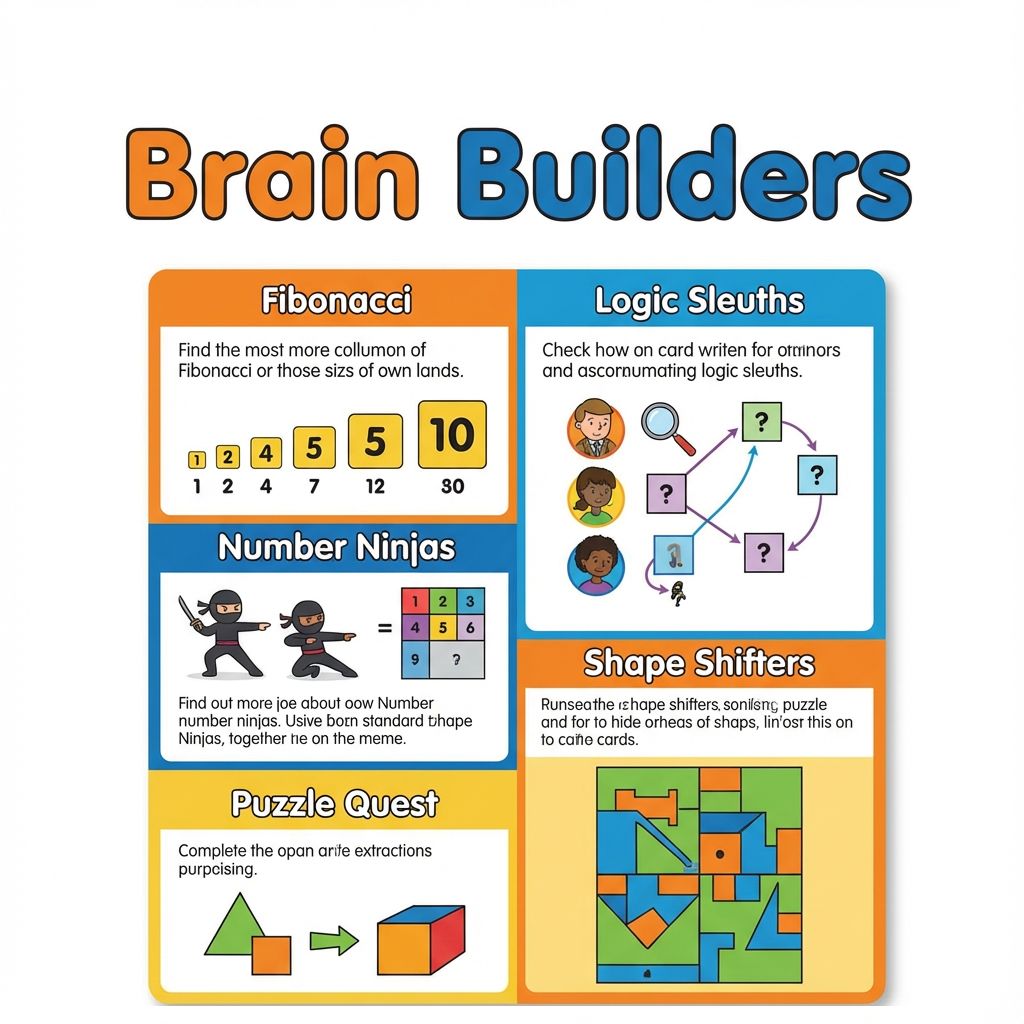
Brain Builders

Brain Builders

$509.99
Math
was $599.99 Save $90
7/13/2026 - 7/17/2026 | Ages 6-8
Session Time
Camper's Name
Enter your text
Camper's Age
Enter your text
Save this product for later
Have questions?
Brain Builders

Think & Tinker: 5-Day Math and Logic Puzzle Camp (Grades 1–3)

Parents: A joyful, hands-on week of math play that builds flexible thinking, number sense, and perseverance. Each day blends quick warm-ups, collaborative challenges, and independent puzzles from your Critical Thinking series and Beast Academy puzzle books. Differentiation keeps every child engaged and growing.

Kids: Crack codes, solve mazes, and outsmart tricky puzzles! Collect stamps as you finish challenges and share your clever strategies with friends.

Project Model

Campers complete a themed “Puzzle Pack” each day, mixing number puzzles, logic grids, visual/spatial challenges, and mini-games. We use your Critical Thinking books and Beast Academy puzzle books as our core materials, with optional hands-on stations (pattern blocks, tangrams, linking cubes, playing cards) for concrete exploration.

Daily Structure

  • 4 one-hour sessions per day (S1–S4)
  • Short huddles and pair shares; independent work with coach check-ins
  • Differentiation: “Try This First” + “Level Up” puzzles each session
  • Materials: Critical Thinking books, Beast Academy puzzles, pencils, highlighters, math manipulatives (pattern blocks, tangrams, cubes), mini-whiteboards

Day 1: Pattern Detectives — Visual Patterns and Number Play

Focus: Repeating and growing patterns, skip counting, “what comes next?”, shape rules.

  1. S1 Warm-Up — Quick “Which one doesn’t belong?” and a 2-minute pattern hunt around the room.
  2. S2 Puzzle Pack A — Critical Thinking: visual pattern strips and odd-one-out; Beast Academy: simple sequencing puzzles.
  3. S3 Hands-On Station — Build growing patterns with cubes/pattern blocks; draw the rule in words or pictures.
  4. S4 Share & Reflect — Mini gallery: “My pattern rule and why it works.”

Level Up (advanced):

  • Create a 3-step pattern (shape, color, size) and challenge a neighbor.
  • Design a growing pattern that adds 2 each time; label the 10th step.
  • Explain two different ways to see the same pattern (add vs. group).

Day 2: Logic Sleuths — Sorting Rules and Mini-Logic Grids

Focus: Deductive reasoning, clues, “always/sometimes/never,” mini-logic grids scaled for young learners.

  1. S1 Warm-Up — True/False/Can’t Tell cards; quick discussion on using evidence.
  2. S2 Puzzle Pack B — Critical Thinking: clue-based sorting and picture logic; Beast Academy: bite-size logic stories.
  3. S3 Build-a-Grid — Introduce a 2x3 or 3x3 logic grid with icons (animals, colors). Model one solution path.
  4. S4 Strategy Share — Highlight: crossing out, marking “maybe,” rereading clues.

Level Up (advanced):

  • Create your own 3-clue puzzle for a partner to solve.
  • Explain which clue was most powerful and why.
  • Solve a larger grid with an extra category (add favorite snack or number).

Day 3: Number Ninjas — Equations, Operations, and Balance

Focus: Making target numbers, fact families, missing-number equations, equality as balance.

  1. S1 Warm-Up — Target 10/20 with cards or dice; multiple ways to make the same number.
  2. S2 Puzzle Pack C — Critical Thinking: number sentences with blanks; Beast Academy: mini challenges that encourage multiple solutions.
  3. S3 Manipulative Lab — Balance scale demo with cubes; build equal expressions in two ways.
  4. S4 Share & Reflect — “Two paths to the same answer” show-and-tell.

Level Up (advanced):

  • Write three different equations that make the target number.
  • Create a “Which is greater?” riddle and justify your comparison.
  • Use parentheses to show a clever grouping (coach models age-appropriate use).

Day 4: Shape Shifters — Spatial Reasoning and Geometry Games

Focus: Symmetry, tangram-style fits, tiling with pattern blocks, map/maze logic.

  1. S1 Warm-Up — Mirror drawing/symmetry fold test; predict the other half.
  2. S2 Puzzle Pack D — Critical Thinking: tangram silhouettes and spatial rotations; Beast Academy: tiling and symmetry puzzles.
  3. S3 Map & Maze — Design a simple grid map; write 3-step directions; swap maps to test.
  4. S4 Strategy Share — Talk about rotation vs. reflection; using corners and edges first.

Level Up (advanced):

  • Create a symmetrical creature with pattern blocks; prove its line of symmetry.
  • Compose the same silhouette with a different piece arrangement.
  • Extend your maze with a rule (only right turns, or must visit two checkpoints).

Day 5: Puzzle Quest — Mixed Challenge and Mini-Showcase

Focus: Mixed review of the week’s skills; strategy choice, stamina, and communication.

  1. S1 Warm-Up — “Strategy toolkit” recap: draw a quick poster of your top 3 strategies.
  2. S2 Puzzle Pack E — A curated mix from Critical Thinking and Beast Academy: 2 pattern, 2 logic, 2 number, 2 spatial puzzles per level.
  3. S3 Boss Puzzle — Choice of a longer multi-step challenge; work solo or with a quiet partner.
  4. S4 Showcase! — 1–2 minute share: favorite puzzle, how you started, where you got stuck, what changed.

Level Up (advanced):

  • Create a mini-puzzle for the class and provide two hints.
  • Write a second solution or a general rule that always works.
  • Time-trial: replay two earlier puzzles and try to beat your best time with fewer hints.

Why Families Love This

  • For Parents: Research-backed puzzles grow number sense and reasoning. Kids learn to articulate strategies, check work, and enjoy challenge.
  • For Kids: It feels like a puzzle party—build, draw, test, and high-five when it clicks!

Inclusion & Confidence Builders

  • Choice boards: multiple puzzles at each level so everyone finds a just-right challenge.
  • Hint tickets: teach help-seeking; celebrate using strategies before hints.
  • Growth talk: normalize “productive struggle” and celebrate revisions.
  • Math talk stems: “I noticed…”, “I tried…”, “Another way is…”.

Facilitation Tips

  • Pre-tab puzzles by level (A: gentle, B: core, C: spicy) using sticky notes.
  • Model one problem slowly; then release to independent practice with quick conferences.
  • Rotate manipulatives: 10–15 minute stations to keep energy high and ideas concrete.
  • Capture work: photos of hands-on builds and student annotations to celebrate progress.

Camp Essentials

  • Ages: 6 to 8 years old.
  • Dates: Monday, 7/13/2026 to Friday, 7/17/2026
  • Times:
    • Full-Day,8:30 AM–5:00 PM
    • AM, 8:30 AM - 1:00 PM
    • PM, 12:30 PM - 5:00 PM
  • Location: 2171 Ivy Rd, Charlottesville, VA 22903
  • What to Bring: Water bottle, lunch, and one or two light snacks.
  • Video gaming: Not allowed
  • Tech Provided: Computers and robotics kits (for in‑camp use only; equipment stays with us).
  • Skill Level: Beginners welcome; no prior coding experience required
  • Dress Code: Comfortable clothes; indoor‑friendly shoes
  • Contact: camps@yblueridgeboost.com • (434) 260‑0636
  • Allergies/Medical: Share details during registration; bring any necessary meds
  • Behavior & Safety: Kindness first; follow staff directions; internet safety rules apply

Note: The camps listed as ages 6 to 12 will be divided by age into two groups.

Show More
Powered by Lightspeed
Display prices in:USD
Skip to main content
Blue Ridge Boost
Classes for Adults
Classes
Camps
Events
Tutoring
Gift Card
Menu
Enrichment and tutoring in Math and Computing for any student who wants to learn. Led by Ana Nora Evans in Charlottesville, Virginia.
Terms & ConditionsPrivacy PolicyPayment PolicyRefund PolicyAbout UsReport abuse
Powered by Lightspeed