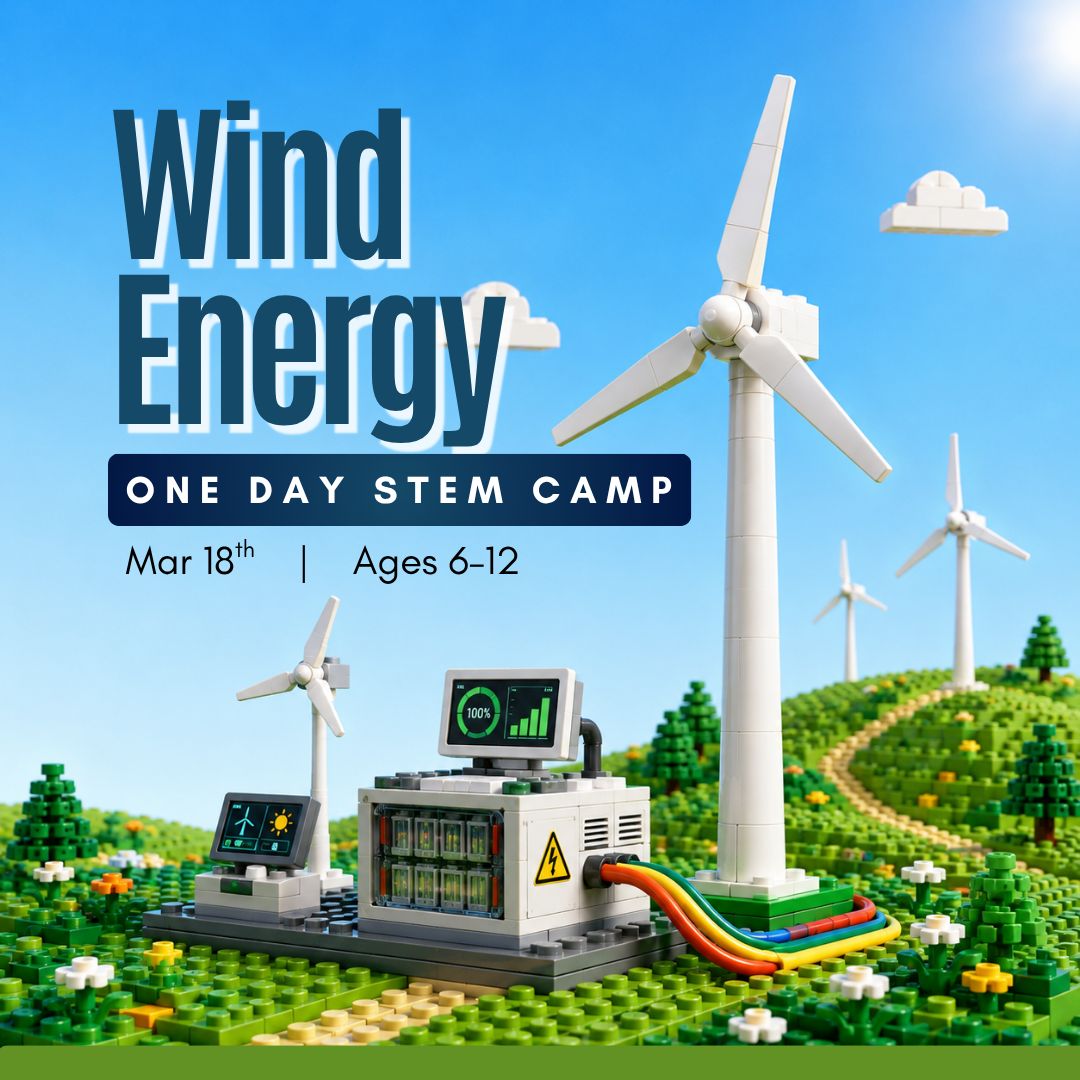
WindWorks Lab One-Day Camp - March 18, 2027
$139.99
Join Now
Length
Grade Level
Gaming during Exploration Time
Child's Name
Enter your text
Child's Age
Enter your text
Save this product for later
Have questions?
WindWorks Lab One-Day Camp - March 18, 2027
Date: 03/18/2027
Camp Topic: STEM & Science Olympiad Building Camp
Wind Turbine Engineering Camp: Build, Test, and Power Up
Parents: A hands-on one-day engineering camp where students explore renewable energy by designing and testing their own wind turbines. Campers in grades 1–3 investigate how moving air can create power through playful, age-appropriate building challenges using blades, towers, and simple generators. Throughout the day, students experiment with shape, size, and materials while practicing the engineering design cycle: build, test, improve, and share. Level Up options are included for older or more advanced campers in grades 4–6.
Kids: Build your own wind turbine and see if you can make it spin faster, stronger, and better! Test different blades, try cool designs, and discover how wind can make energy. You’ll think like an engineer as you build, test, and improve your turbine.
Project Model
Campers design and test beginner-friendly wind turbine models using simple materials and guided engineering challenges. Students explore how blade shape, number of blades, angle, and materials affect turbine performance. Activities are designed for grades 1–3, with optional Level Up extensions that add more advanced data collection, variables, and optimization for grades 4–6.
Daily Structure
4 ninety-minute sessions per day (S1–S4)
Hands-on engineering, wind testing, redesign, and sharing
Differentiation built into each session with Try This First for grades 1–3 and Level Up for grades 4–6
Tools: Wind turbine kits or build materials, fans or wind tunnel, measuring tools, simple recording sheets
Build a Better Wind Turbine
Outcomes: Learn how wind turbines work, build a first model, test different blade designs, and improve performance through engineering and observation.
S1 What Makes Wind Work?
Activities: Campers learn how wind energy works and explore the main parts of a wind turbine, such as blades, hub, tower, and generator. Students see how wind can make blades spin and begin thinking about what might make a turbine work well.
Words: wind energy, blade, tower, spin, power, turbine.
Try This First: Explore a simple turbine model and identify its main parts.
Level Up: Predict how changing blade shape or size might affect performance.
S2 Build Your First Turbine
Activities: Build a simple wind turbine and test it with a fan or wind tunnel. Campers observe how the blades move and record what happens during their first trial.
Try This First: Build a working turbine that spins in moving air.
Level Up: Adjust blade placement or angle to improve the spin.
S3 Blade Design Challenge
Activities: Test different blade shapes, lengths, or materials to see which design works best. Campers compare results and decide what changes to make next.
Try This First: Try two different blade styles and compare which one spins better.
Level Up: Change one variable at a time and track which design creates the best performance.
S4 Test, Improve, and Share
Activities: Campers redesign their turbine, test it again, and share what they discovered. Students explain what they changed and how it affected their turbine’s performance.
Reflection: What change helped your turbine the most? What would you try next?
Level Up: Combine your best blade design with a stronger tower or more advanced setup.
Why Families Love This
For Parents: This camp gives students a strong introduction to renewable energy, engineering, and real-world problem-solving through hands-on exploration. Campers build confidence as they test ideas, collect observations, and improve their designs in a supportive environment.
For Campers: You get to build cool turbines, test them in the wind, and see if your design can become the strongest one.
Inclusion & Confidence Builders
- Beginner-friendly engineering challenges designed for grades 1–3
- Level Up options available for grades 4–6
- Clear build-test-improve structure
- Multiple chances to redesign and succeed
- Focus on curiosity, creativity, and problem-solving rather than perfection
Camp Essentials
Ages: Grades 1–3, with Level Up challenge options for grades 4–6
Times:
- Full-Day: 8:30 AM–5:00 PM
- AM: 8:30 AM–1:00 PM
Location: 2171 Ivy Rd, Charlottesville, VA 22903
What to Bring: Water bottle, lunch, and one or two light snacks
Video Gaming: Not allowed
Tech Provided: Computers and robotics kits (for in-camp use only; equipment stays with us)
Skill Level: Beginners welcome; no prior engineering experience required
Dress Code: Comfortable clothes; indoor-friendly shoes
Contact: camps@yblueridgeboost.com • (434) 260‑0636
Allergies/Medical: Share details during registration; bring any necessary meds
Behavior & Safety: Kindness first; follow staff directions; careful use of materials and testing equipment required
Note: Camps listed for ages 6 to 12 may be divided into two groups by age.
Powered by Lightspeed
Display prices in:USD