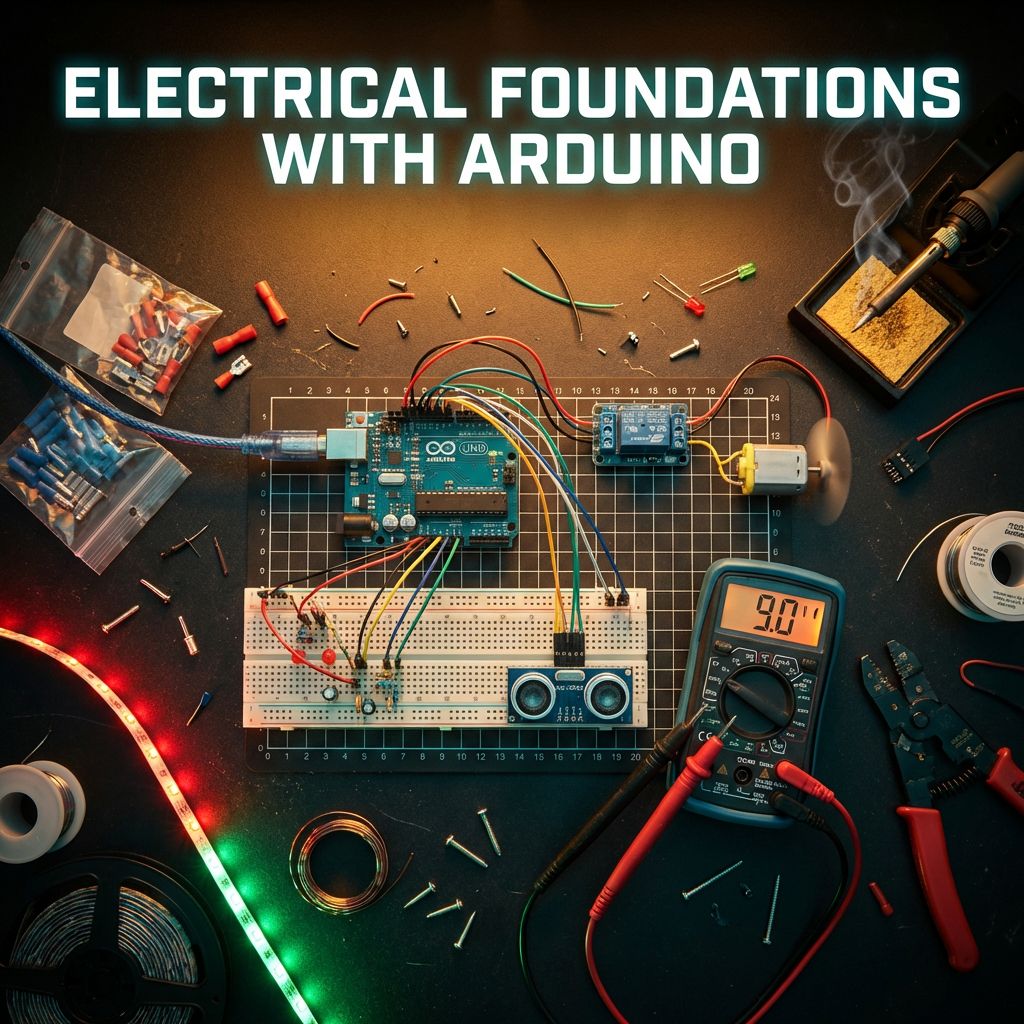
Electrical Foundations with Arduino
$1 299.99
June 22-26 & June 29-July 3 | Ages 13-18 | Robotics
Type
Please choose
Save this product for later
Have questions?
Electrical Foundations with Arduino
Camper's Age: Ages 13-18
Camp Topic: Robotics
Camp Week: Week 4-5 (June 22-26 & 29-31)
Gaming: No gaming
Ages 13–15 | 5-Day Full-Day or 10-Day Half-Day
Build real circuits from scratch, measure voltage and current with a multimeter, program an Arduino to control motors and read sensors, and assemble a complete electronics panel. Curriculum developed by the Carnegie Mellon Robotics Academy (SMART Robotics Technician Program).
Full-Day Schedule (5 Days, 4 sessions/day)
Day 1 — First Circuits & the Multimeter
| Session | Project |
|---|---|
| AM 1 | Identify components (wires, resistors, LEDs, switches, batteries); crimp connectors and construct wires |
| AM 2 | Build a basic circuit — wire a battery, switch, and LED; test continuity with a multimeter |
| PM 1 | Measure voltage across components; add a second switch to control power paths |
| PM 2 | Project: Lightbox — assemble a lighted enclosure using all wiring, battery, and switch skills from the day |
Day 2 — Parallel & Series Circuits / Motors
| Session | Project |
|---|---|
| AM 1 | Wire series vs. parallel circuits; measure voltage drops across each configuration |
| AM 2 | Project: LED Sign — design and build a multi-LED parallel circuit that keeps all LEDs lit independently |
| PM 1 | Introduce current — power a DC motor; use the multimeter to measure current draw |
| PM 2 | Project: Motorized Fan — wire a motor circuit with proper voltage/current supply and a control switch |
Day 3 — Arduino & Signal Control
| Session | Project |
|---|---|
| AM 1 | Set up the Arduino IDE; upload a Blink sketch; understand digital HIGH/LOW signals |
| AM 2 | Use the Arduino as a programmable voltage source — control an LED's brightness with PWM |
| PM 1 | Wire a relay module — write code to switch a motor on/off via Arduino digital output |
| PM 2 | Motor control board — program speed and direction changes; combine relay and PWM for variable motor control |
Day 4 — Sensors & Autonomous Behavior
| Session | Project |
|---|---|
| AM 1 | Wire a limit switch (COM, NO, NC terminals); write code to detect presses and trigger motor actions |
| AM 2 | Wire an ultrasonic distance sensor; code real-time distance readings and threshold-based reactions |
| PM 1 | Combine both sensors — code logic that reacts to proximity and contact events |
| PM 2 | Project: Autonomous Kicker — build a mechanism that detects an object with the distance sensor, then kicks it using a motor triggered by the limit switch |
Day 5 — E-Panel Assembly & Soldering
| Session | Project |
|---|---|
| AM 1 | Soldering fundamentals — tool safety, tinning, heating technique, flux; practice joints and check with multimeter |
| AM 2 | Plan the e-panel layout — map component placement, measure and cut wires to size |
| PM 1 | Build wiring harnesses with conduit; label all connections for easy troubleshooting |
| PM 2 | Final Project: Electronics Panel — assemble a complete e-panel integrating battery, switches, Arduino, relay, motor, and sensors into one organized system |
Half-Day Schedule (10 Days, 2 sessions/day)
| Days | Content |
|---|---|
| Days 1–2 | First Circuits & the Multimeter (Full-Day 1 content) |
| Days 3–4 | Parallel & Series Circuits / Motors (Full-Day 2 content) |
| Days 5–6 | Arduino & Signal Control (Full-Day 3 content) |
| Days 7–8 | Sensors & Autonomous Behavior (Full-Day 4 content) |
| Days 9–10 | E-Panel Assembly & Soldering (Full-Day 5 content) |
What You'll Build
- Lightbox with battery, switches, and wired LED circuit
- Multi-LED parallel circuit sign
- Motorized fan with current-managed power supply
- Arduino-controlled relay and PWM motor system
- Autonomous Kicker using limit switch and ultrasonic sensor
- Complete electronics panel with labeled wiring harnesses
- Soldered circuit joints
Tools & Technologies
- Arduino microcontroller & IDE
- Digital multimeter (continuity, voltage, current)
- Relay modules, motor control boards
- Limit switches, ultrasonic distance sensors
- Soldering iron, solder, flux
- Crimping tools, wire strippers, conduit
Powered by Lightspeed
Display prices in:USD